new thread


I just had an interesting thought.
I've always heard that you could match a graph of the economy to a graph of women's skirt lengths, i.e. a boom corresponds to mini skirts and a slump matches up with ankle length.
It just occurred to me that the economic recovery is just beginning and long hair is coming back in. Does anyone think there's a correlation? Is there a hair length cycle that correlates with economic statistics? Does anyone have a theory why? (I have one, but I would like to see responses first)
Not to mention, the economy is starting to recover and it is summer, so we can look forward to seeing lots of girls in mini skirts! Hurray!

Well, I wager my theory is the same as yours:
During an economic downturn, unemployed guys will cut their hair to increase their chances of getting a job.
It certainly makes more sense as an economic indicator than skirt length. Perhaps that one comes about because women are more interested in attracting a potential mate when times are good; but it doesn't seem like women are in total control of the fashion industry. Maybe good economic times encourage men in the fashion industry to take more risks in what they push to the market.
That makes sense, but why was the low-point for hair length in 1998, when times were booming? Why have we seen so much more long hair in the last few years, when the economy has tanked? 1969 was also a tough year to find a job, and we know many manes were flyin' that year!
My hypothesis has been that each generation does not want to look like dad, so we see ripples in the curve about as long as a generation. Gay and straight people do not want to look like each other, so gay and straight crowds go through the same ripples but seem to be out of phase.
A couple of years ago I plotted the age distribution of a gay longhair group against this group (we'd just had a thread on "how old are you"). This is what I got:
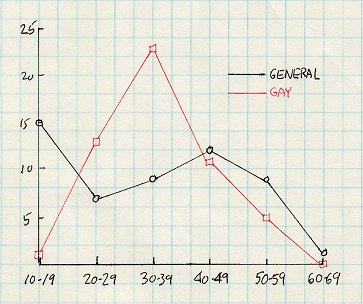
Wow! You've got empirical evidence to back up your theory. I've got no studies to put up against it. Not many data points though, and there's probably bias in the sample being limited to people who:
1. Have Internet access
2. Are passionate enough about their appearance to post online about it.
The generational concept is compelling though--my parents are WWII but they had me late so most of my contemporaries have Boomer parents--and short hair. A longer timeline on your graph would be interesting. I think you'd see an "explosion" in the 1960s so powerful that any fluctuation after that would appear to be statisticly insignificant--at least among Caucasians. Native Americans and certain other ethnic groups would probably have totally different looking graphs.
Bill's theory seems to have something to it. For example, my son has short hair.

